
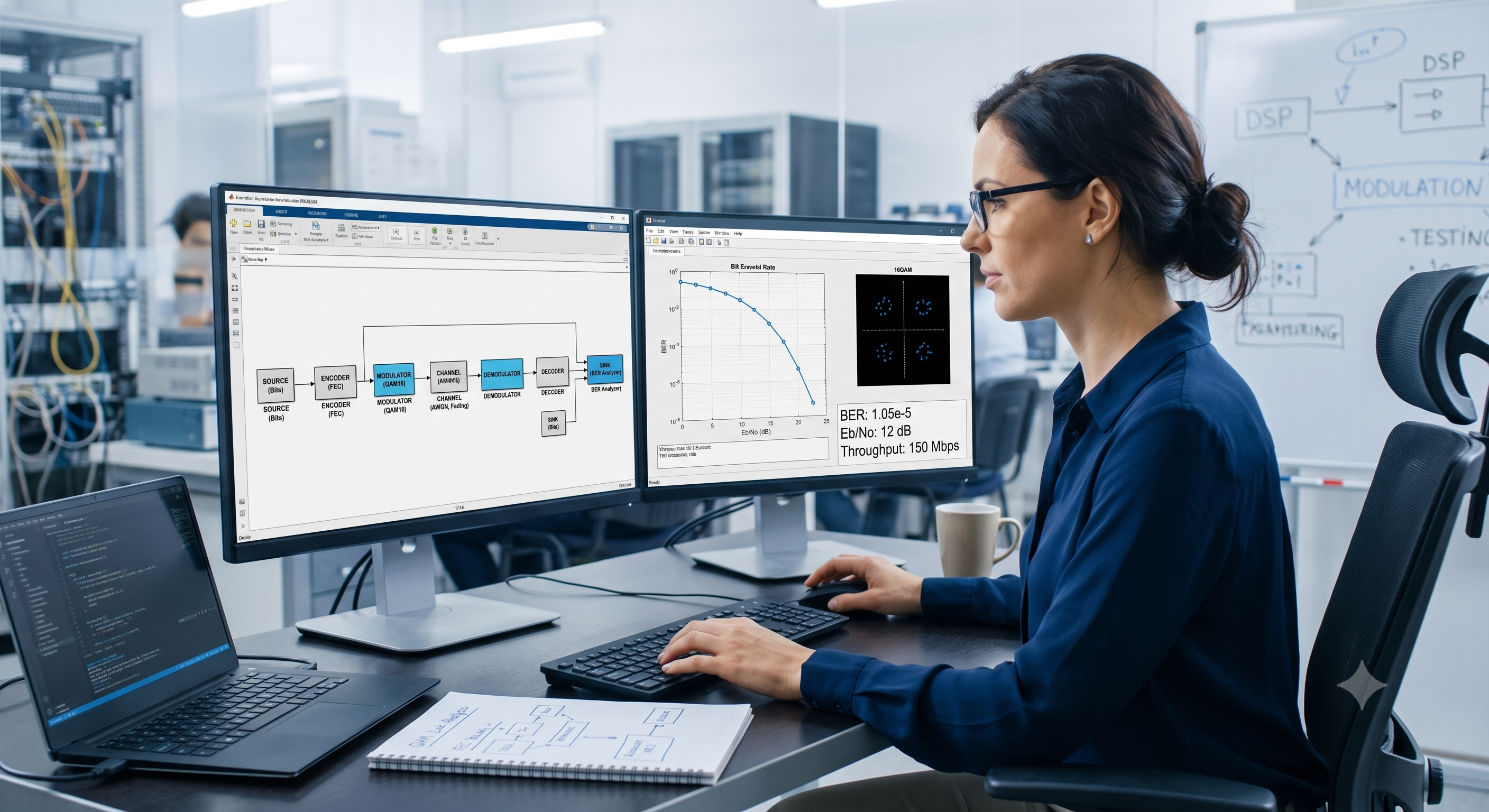
Block-Level Simulation Workflows
Build and verify complex digital communication models using structured block simulators to analyze end-to-end link performance.
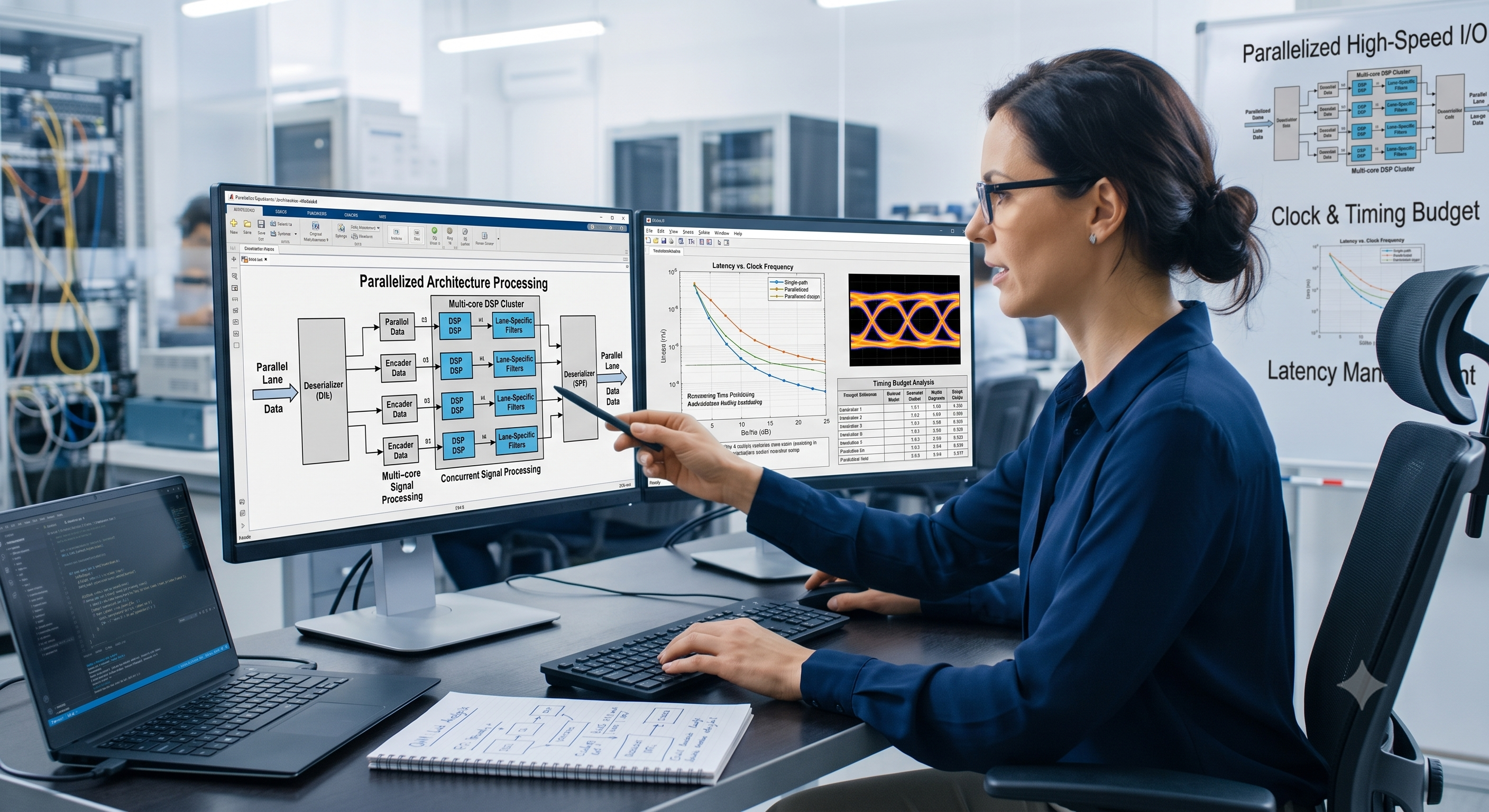
Parallelized Architecture Processing
Understand and implement parallelized systems designed to overcome physical timing limitations in ultra-high-speed transceivers.
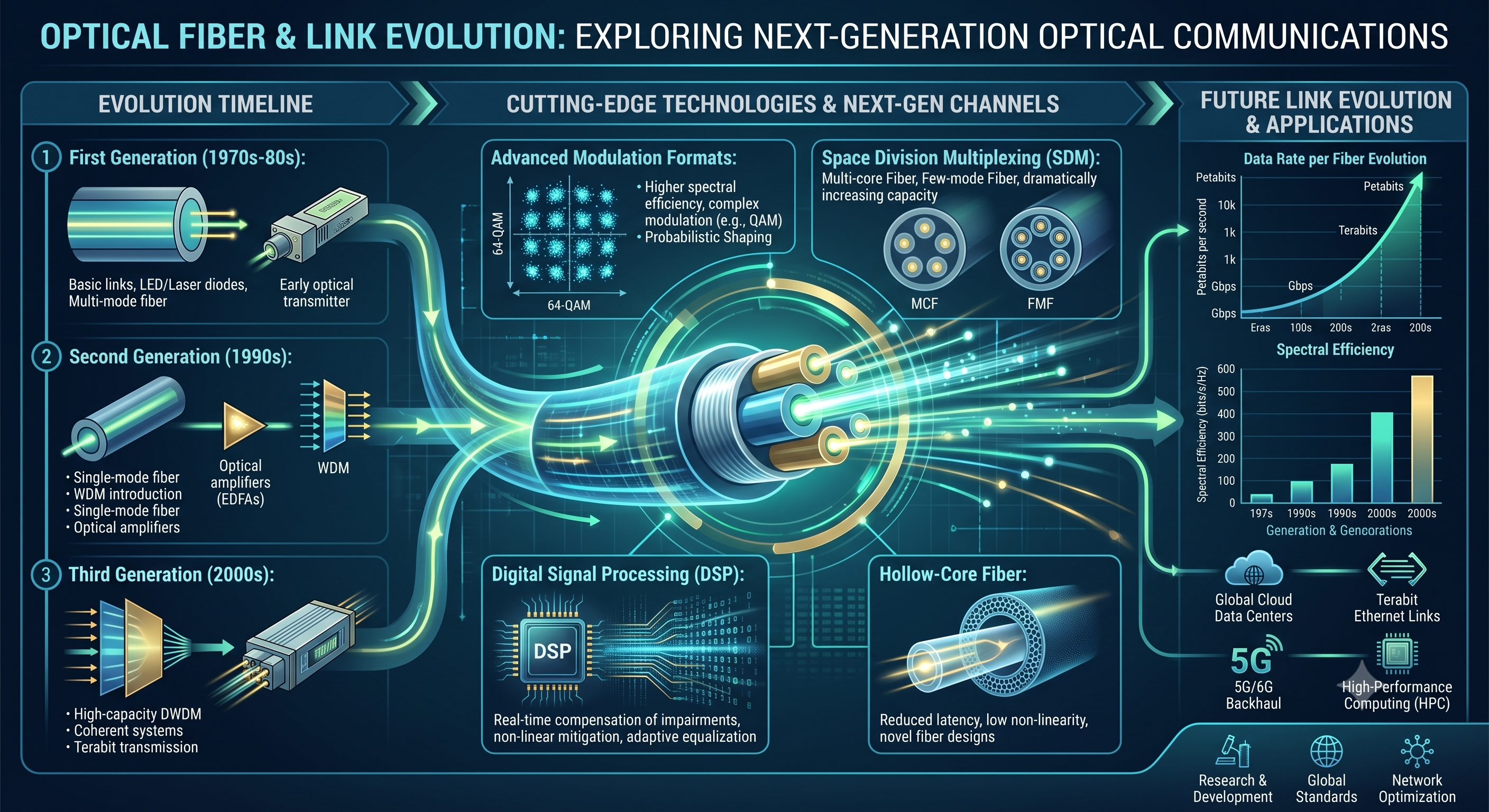
Optical Fiber & Link Evolution
Analyze cutting-edge optical communications, exploring the evolution of fiber optic technologies and next-generation optical channels.
About the Course
This course dives deep into the engineering workflows used by top-tier semiconductor and aerospace companies. Students transition from theoretical floating-point representations to rigorous fixed-point block-level simulations, learning how to model finite-precision arithmetic, quantization noise, and hardware overflow conditions. A major focal point of the syllabus is the mastery of parallelized communication architectures. As modern transceivers scale to handle hundreds of gigabits per second, traditional sequential processing reaches its physical timing limits. This course provides the structural frameworks necessary to design, analyze, and optimize parallelized digital signal processing (DSP) pipelines that overcome these hardware bottlenecks. Furthermore, the course explores the physical frontier of high-speed data transfer: Optical Communications and Fiber Evolution. Students will analyze the evolution of optical channels, design high-capacity link budgets, and understand the architectural demands of next-generation coherent optical transceivers.

Meet Your Instructor
Prof. Joel Saliba is a senior hardware engineer and academic specializing in high-speed digital communications, advanced Digital Signal Processing (DSP) architectures, and embedded system design. With years of experience driving technical innovation in both corporate R&D environments and institutional research labs, his work focuses on the intersection of communication theory and physical silicon implementation. At the Fulgor Institute of Technology (FIT), Prof. Saliba leads the Digital Communications and Systems tracks. His expertise spans the design of parallelized transceiver architectures, fixed-point optimization for application-specific integrated circuits (ASICs), and the development of robust, block-level simulation environments for next-generation telecommunication links. Known for his rigorous and hands-on pedagogical approach, Prof. Saliba designs his courses to match the exact demands of the global tech industry. His teaching methodology ensures that students do not just memorize mathematical models, but develop the engineering intuition and practical documentation skills—utilizing industry-standard tools and formal LaTeX frameworks—required to build real-world, high-throughput communication systems.
Course Curriculum
-
1
-
(Included in full purchase)
Bibliografía
-
(Included in full purchase)
Clase 1
-
(Included in full purchase)
Repaso EM
-
(Included in full purchase)
Clase 2
-
(Included in full purchase)
Repaso de Elecrtromagnetismo y Óptica
-
(Included in full purchase)
Clase 2 - Explicación
-
(Included in full purchase)
Clase 3
-
(Included in full purchase)
Clase 3 - Repaso DSP
-
(Included in full purchase)
Tools
-
(Included in full purchase)
Clase 4
-
(Included in full purchase)
Clase 4 - Repaso
-
(Included in full purchase)
Clase 4
-
(Included in full purchase)
Clase 5
-
(Included in full purchase)
Intro Comunicación Óptica
-
(Included in full purchase)
Clase 6
-
(Included in full purchase)
Material Clase 6
-
(Included in full purchase)
Clase 7
-
(Included in full purchase)
Clase 7
-
(Included in full purchase)
Clase 7 - Bibliografia
-
(Included in full purchase)
-
2
-
(Included in full purchase)
Developing a Communication Plan
-
(Included in full purchase)
-
3
-
(Included in full purchase)
Adjusting Your Strategies
-
(Included in full purchase)
-
4
-
(Included in full purchase)
Staying Ahead in Digital Communication
-
(Included in full purchase)
Student Testimonials
Discover how our course has helped individuals like you enhance their digital communication skills and achieve their goals.
Before taking Digital Communications II at FIT, my understanding of signal processing was mostly limited to theoretical floating-point math. Prof. Joel Saliba’s focus on fixed-point simulation and parallelized architectures completely changed how I approach system design.
Córdoba, Argentina

The curriculum for Digital Communications II is exceptionally well-structured and aligned with what the tech industry actually demands today. The deep dive into optical fiber evolution, high-speed link budgets, and parallelized processing gave me the tools to understand next-generation transceivers from the ground up.
Buenos Aires, Argentina
Before taking Digital Communications II at FIT, my understanding of signal processing was mostly limited to theoretical floating-point math. Prof. Joel Saliba’s focus on fixed-point simulation and parallelized architectures completely changed how I approach system design.
Córdoba, Argentina
The curriculum for Digital Communications II is exceptionally well-structured and aligned with what the tech industry actually demands today. The deep dive into optical fiber evolution, high-speed link budgets, and parallelized processing gave me the tools to understand next-generation transceivers from the ground up.
Buenos Aires, Argentina
Ready to Transform Your Digital Presence?
Join our course today and unlock the potential of effective digital communication strategies. Take the first step towards success!